Thursday, June 2, 2011

Backyard Marmalade (Take Two!)


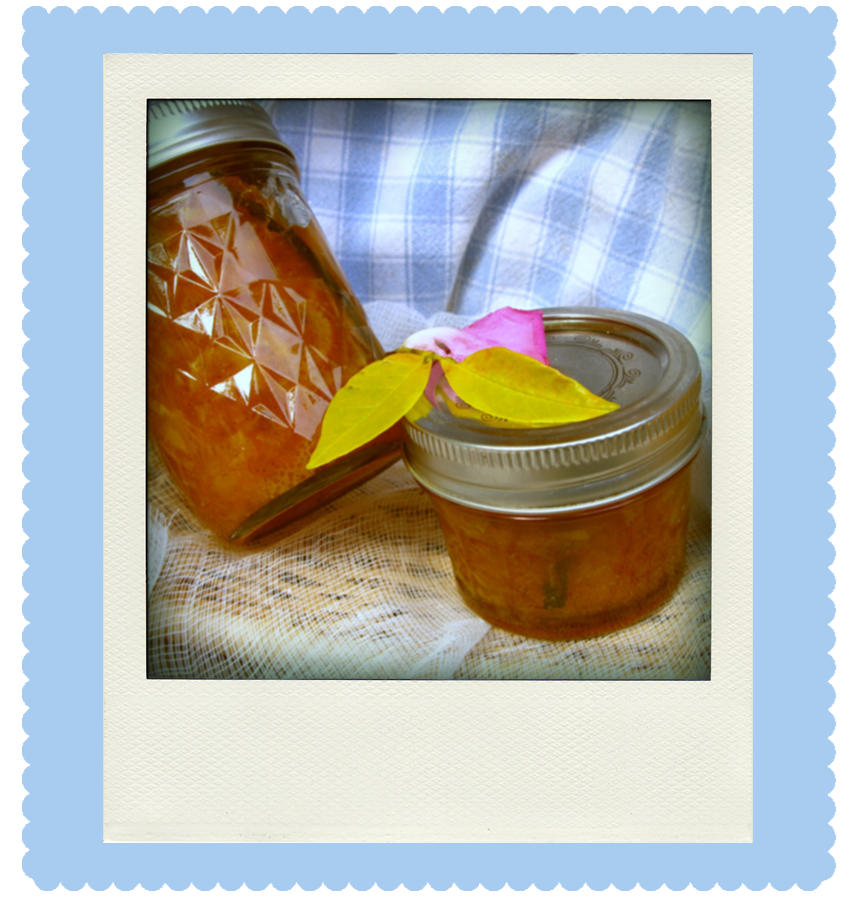
This time our marmalade attempts were a success! Unlike
last time, this marmalade, made up of Meyer lemons and oranges, set up beautifully. It only had the tiniest hint of bitterness, which, I've learned, is appropriate for a good marmalade. Barry says that it is "the best marmalade I've ever had". It really is delicious. The vanilla bean adds some depth that I wasn't expecting. Since we made this batch, we've made several more batches - even one with strawberries! They've all been yummy. Here's the basic recipe and instructions.


Backyard Marmalade

Overview
This method is a two day process but don't let that scare you away. I found it much easier to divide the work over two days instead of trying to do everything in one day. You can enjoy it more, plus the flavors really develop when you let it sit overnight. I also used a different method for the oranges and the Meyer lemons. Because the Meyer lemons have such thin skin, you don't have to take off the white pith, which makes things much easier!

Ingredients
10 Meyer Lemons
10 sweet oranges (We're not sure what type our backyard oranges are.)
6 cups of sugar
1 vanilla bean

Special Equipment
Small Canning jars (I used 8 oz and 4 oz jars)
Canning equipment
Cheesecloth
Candy thermometer (optional)

Day One

1. Wash and dry all fruit. I used 10 Meyer lemons and 10 oranges. (We're not sure of the exact variety of our backyard oranges. They are sweet and very juicy!)

2. Using a vegetable peeler, remove the zest from the oranges. Avoid as much of the white pith as possible. Cut the zest into thin ribbons using a large chef's knife and place in a nonreactive pot. (You want them thinner than what is pictured to the side. I hadn't finished cutting them.)

3.
Oranges
Take the pith-covered oranges and cut the ends off. Set the orange up on end and, working around the whole orange, cut off the bitter pith.

4. Using a paring knife and holding the orange over your pot with the zest, separate the orange segments from the membrane and drop into the bowl. Here's a great
how-to video that I found. Also remove any seeds you find and place in another clean bowl. Once you've finished with an orange, squeeze out all the juice from the membrane into your pot and place the remaining membrane with the discarded seeds to save for later.

5.
Meyer Lemons
Cut each Meyer lemon in half and, working over your pot, use a paring knife to make a notch and cut around the membranous middle. Here is a great picture of the process. Squeeze juice from this middle section into the pot and then place the membrane aside in your membrane/seed bowl. Use your fingers to remove any seeds from the rest of the lemon, dropping them into your membrane/seed bowl.

6. Using a sharp knife, cut the lemons into thin slices.
You don't have to separate the peel from the flesh. Add slices to the pot.

7. Drain any extra juice from your membrane/seed bowl into the pot.

8. Cover the fruit with water and simmer for 5 minutes. Let mixture cool and then place in the fridge overnight.

9. Place your reserved membranes and seeds in the center of a large cheesecloth square. Tie corners tightly together and place on a plate in the refrigerator.


Day Two

1. Sterilize the jars you plan to use and simmer the lids in a small pot. My marmalade made enough to fill six 8 oz and three 4 oz jars.

2. Slice your vanilla bean lengthwise and use a small knife or your thumb to remove the seeds. Add seeds to the orange/lemon mixture. Also add empty vanilla bean pods to the pot.

3. Simmer mixture for 5 minutes and then add 6 cups of sugar.

4. Boil mixture until it reaches the jelling point (check the wrinkle test) and/or 220 F (Mine only got to 216 F). The wrinkle test is done by placing a spoonful of marmalade on a chilled surface. I used a clean jar lid that had been in the freezer for 30 minutes. It should still be thin at this point. Return after a few minutes to see if it passes the wrinkle test, which means it will have thickened up and will wrinkle with you push it with your finger. You may have to add some added pectin at this point. Mine worked out fine but on a later batche (probably when I used less sugar), I had to add some pectin. Note: It should not be the consistency of marmalade at this point. It will seem much too thin and runny. It will thicken to the final consistency when cooled. However, it
should pass the above tests. If it does not, it won't be thick enough later.

5. Remove the vanilla bean from the mixture and rinse. Cut into smaller lengths to add to your jars before processing.

6. Ladle mixture into jars and add your vanilla bean pieces. Clean jar rims before placing sterilized lids and screwing them down tight. Process in a water bath canner for 10 minutes.

7. Enjoy!

Three helpful sources that I referenced:

    Sunday, May 22, 2011

    Loquats, Haiku, and the Good Life

    Until last week, we didn't even know that loquats existed, but one of our neighbors gave us some on Friday. They had a decadent, faintly tropical flavor. Sweet and juicy, they were more like an apricot than anything else, but also possessed undeniable notes of mangosteen, kumquat, and--with some imaginative insight--even apple. They were too good to squander on fresh eating alone, so we decided to preserve some of them as loquat jam.
    This morning, I looked up loquats on Wikipedia. They originated in Southeastern China, home to a famous poet, Li Bai, who mentioned them frequently in his poems. There's something sublime about oriental art. Take this painting of loquats.
    Or this beautiful haiku by the great Bashuo Matsuo himself:

    An old silent pond...
    A frog jumps into the pond
    splash! Silence again.

    What is the Good Life? It is living simply, joyfully, and without affectation, watching a frog jump into a pond, for instance, or making loquat jam.

    Tuesday, May 17, 2011

    God, Galileo, and Grumpy Teddy Bears: Part 3

    God, Galileo
    and the Grumpy Teddy Bears
    what was I thinking?

    Well, it all started over a breakfast conversation with Christy. She was having a hard time getting much from the gospels during morning devotions. I sympathized. Like Christy, I had grown up in a Christian home and heard the gospel stories so many times that my original fascination was long gone. Then it occurred to me that our struggle to appreciate the gospels exemplified one of the great vexations of life: familiarity breeds contempt.

    Yes, familiarity may also breed fondness, but not often, not without effort, pain, and frustration. And most of the time, we don't think it's worth it. We prefer something new, or if this is not available, then stronger doses of the old, anything but the same old same old.

    This insatiable thirst for novelty is not all bad. Exploring, learning, growing--these are good things and we are made to engage in them. But engage is the key word. Newness alone will not create the joy of a new experience. We must engage the new and often sacrifice our comfort in the doing.

    Engagement connotes action, attention, and commitment. If Navy SEALS attack the Taliban in Afghanistan, the ensuing engagement is forceful, focused, and totally committed. When gears engage, they move in sync, irrevocably linked until release. Getting engaged to Christy was a moment of supremely attentive action entailing a lifelong commitment.

    Engagement is a total, all encompassing experience, and we are afraid of it. When we fail to engage a new experience, however, the newness soon wears out. Hence our malaise with the old and desperate search for the new.

    Ironically, the harder we try to shun the old, the less successful we become. Perhaps this is because the greatest source of discovery lies in the ordinary old everyday things of life. Indeed, as Galileo and the Grumpy Teddy Bears demonstrate, engagement with the ordinary reveals a vast world of untapped newness. And it is this exhaustless world of beauty and variety which brings me God.

    There is a broad consensus among many thoughtful and spiritual people that Jesus transmitted Divinity to the world. Exactly how or why he did this is hotly debated with little resolution, principally because all groups with an interest have disparate--and unmovable--a priori commitments. Few, however, turn to the gospel accounts for a look at Jesus sans religious and intellectual baggage. Suppose we tried, what would we see?

    Well, what I see is a man who is above all supremely engaged in life. He is engaged with such fierce attention that his every act becomes a moment of creative commitment. For him, the ordinary is anything but mundane. Every leprous beggar, prostitute, and pharisee is precious, full of hidden newness waiting to be recognized. To me, this is the essence of Divinity. This is Love personified. This is God.

    Friday, April 22, 2011

    God, Galileo, and Grumpy Teddy Bears: Part 2

    Galileo was in church one day, gazing absently at the tall ceilings and ornate stain glass windows. He was twenty, failing medical school at the University of Pisa, and not sure what he wanted from life. At fifteen, he had decided to become a monk, but his father sent him to medical school at the tender age of seventeen instead. Now he was failing.

    A large lamp caught his eye as it swung a ponderous arc through the air, back and forth, back and forth. Suddenly, Galileo saw more than just a swinging lamp, and what he saw got him thinking. Within in a short time, he had developed a principle which revolutionized time-keeping and kick started the modern science of mechanics: the law of the pendulum.

    To be honest, that story is probably a myth. What it teaches about Galileo, however, is almost certainly true. Galileo had a curious, questioning mind. He found profound new insights in the most commonplace, ho-hum things of life--like swinging lamps. For him, the ordinary held potential for endless discovery.

    To be continued...

    Tuesday, April 19, 2011

    Sustainable eating and Fresh Strawberry Tarts!

    Last week I bought a flat of fresh strawberries from the farmer's market, along with some beautiful rainbow chard, broccoli, and sugar snap peas! We enjoyed having such quality and delicious produce to experiment with, and it got me thinking about some ethical food issues that I've been mulling over lately: eating local and eating food that is in season.

    There are a host of benefits to eating locally and seasonally. It's fresh, healthy, and sustainable. But there are a few downfalls too, mainly having to do with cost. There is just no getting around the fact that it costs more to shop at a Farmer's Market and other local sources then to go to Superior's, Winco, or Food4Less (my main sources for cheap food). For Barry and I, operating on a very tight budget, it's hard to make the leap.

    We haven't decided to convert 100% to eating local and in season - we're just not to that point yet. But we are much more conscious about where our food comes from. It feels (and tastes!) so much better to pay extra in support of local farmers than to have our produce shipped all the way up from Mexico, where they sprayed it with who knows what. And when it does arrive, it is covered in wax and far from fresh.

    So for now, we've made a few changes to our food budget. We haven't increased it, but we have allocated more funds to a Farmer's Market trip once a month. We'll continue to reassess as time passes and make changes as needed. It's a step in the right direction, and I'm excited to see how it goes!

    Now, back to the point: Fresh Strawberry Tarts! There's nothing quite like the simple joy of biting into a freshly made strawberry tart! It's strawberry season right now, and I'm planning to make the most of it!


    Fresh Strawberry Tarts
    Makes 4-5 small tarts
    Crust
    9 graham crackers, crushed
    4 Tbsp margarine, melted

    Hint: Usually I use a mixture of blended nuts for my crust. It's delicious and requires no added fat. If you run out of graham crackers or don't have any, blend 1-2 cups of nuts and skip the butter. You can also use a combination of nuts and graham crackers. That tastes splendid also!

    Creamy Filling
    2 blocks tofu
    4 oz Cream Cheese (that happened to be the amount I had left. Use whatever you've got or not at all. If you skip the cream cheese, add extra vanilla flavoring.)
    Scant 1/4 cup sugar
    Juice of 1/2 a meyer lemon
    1/2 tsp vanilla flavoring

    Strawberry Sauce
    1 cup strawberries, washed and hulled
    Sugar, to taste
    Juice from 1/2 a meyer lemon

    Garnish
    Sliced strawberries
    Mint leaves

    Directions:
    • Mix crushed graham crackers and butter in a bowl and press into small tart pans to create a firm crust.
    • Blend tofu, cream cheese, sugar, lemon juice, and vanilla in blender until smooth. Pour into prepared tart crusts. Smooth with spatula or spoon.
    • Blend strawberries, sugar, and lemon juice in a blender until smooth. Pour over top of the creamy filling in the tarts.
    • Garnish with sliced strawberries and mint leaves.
    • Chill & enjoy!

    Saturday, April 16, 2011

    God, Galileo, and Grumpy Teddy Bears: Part 1

    My brother John and I used to play with teddy bears. We called it "ams", short for stuffed animals. Usually during breakfast, while Mom or Dad were saying something about chores or homework, John and I would exchange meaningful glances. Then, like escaping prisoners, we would stealthily flee to John's room for a game of ams.

    We had about twenty teddy bears, each a distinct and truly fascinating personality. There was Beav the cunning commando and his inseparable comrade Sam. We had Fox the incomparable scientist, mystic, and military strategist, and Grey, the good hearted duffer with a talent for mistakenly starting every fight on the wrong side (he generally saw his error and changed sides just at the moment of dire necessity).

    Yes, those were the good old days. Without a TV, video games, or even much fiction, we invented our own imaginative stories and learned to see something extraordinary in a mundane collection of teddy bears.

    Our teddy bears live a placid life these days. Mom and Dad take them out when young children visit, but the dramatic vision of bygone days is not relived. A part of me still imagines those teddy bears are alive, and I wonder sometimes if they are getting grumpy with so little excitement.

    To be continued...