Showing posts with label christy. Show all posts

Sunday, February 27, 2011

Backyard Living: Curing Olives

Living in Southern California has opened up a new world to us agriculturally.  Barry and I both grew up in families who gardened, but neither of us have ever lived in a place with such abundant food growing everywhere!  One crop that grows here and is ignored a lot of the time is the olive tree.  My friend Nellie and I went olive picking at a church member's home last fall and we are now reaping the results.

The following method is one that I decided on after doing lots of internet research.  There are many other ways to do it, but we decided on the following because it was less complicated.


After picking the olives, you wash and dry them.


Then you make 1 or 2 cuts in the flesh of each olive so that the bitter acid will leech out.  This takes a bit of time but with more than one person helping, it can go pretty fast.


Next you place them in a salt brine (about 1/4 cup salt per quart) and let them soak, and soak, and soak.  A large glass container or several quart jars works best for this.  (Note: do NOT soak them in stainless steel.  We tried this and discovered that, if pressed against the metal for an extended period of time, the acid in the olives would actually begin to eat away at the metal.)  The salt water should be changed every 4-7 days depending on the amount of salt you used.  


After about 2 months of soaking (although it can be longer or shorter depending on the size), the olives should be quite edible!  Taste one and see what you think.  If they are still somewhat bitter, soak them for 1-2 more weeks. If they are too salty, place them in clean water (no salt) to draw out the sodium.  

You can then season them with things such as garlic cloves, lemon slices, and bay leaves.  Place them in a quart jar with a lightly salted brine and the seasonings.  Pour a thin layer of olive oil on top to seal.  They can then be kept for up to a year (if they last that long!)


To tell the truth, this post is not just about olives.  It's about being creative with what you have on hand, instead of spending money in order to satisfy every need or desire that crops up.  It doesn't have to be olives or persimmons.  For you, it may mean saving and reusing the fabric from old clothing, or making a commitment to avoid food waste.  Whatever it may be for you, be assured that it makes a difference!

Friday, January 21, 2011

Clutter

I read recently in an article (I think from Runners World) that there are two reasons we clutter our life with things. The first is by preparing for the future - keeping all sorts of things because we think we might need it someday! The second way is for remembering the past - keeping all the sentimental mementos from our yesteryears. If overdone, both detract from the present.

Over Christmas break one of my jobs at home was to go through quite a few boxes of my stuff. When Barry and I moved to California, we only brought a limited amount of our belongings. For me, a lot of stuff got left at my parent's place. But I began to wonder, if it wasn't important enough for me to bring to California, did I really need it in the first place?

I come from long line of savers. My Dad and Grampie fit the futuristic saver prototype. They keep all sorts of things for that day far in the future when they just might need it. My Mom and Grammie are more of the past saver types. (But I must note that they both have been doing a LOT of sorting and decluttering lately! I'm so proud of them!)

As I sorted through my belongings, I came to realize that I was definitely a saver. Maybe not an extreme one, but at least a mild one. For remembering the past, I have a whole tub full of small notes, letters, and mementos from my highschool days. Birthday cards, mission trip DVDs... They all got tossed into that tub. As far as saving for the future goes, I have a trunk full of little dresses, my favorite doll and all her handmade clothes that my great grandmother (or was it my great, great grandmother??) made, and other things of such nature that I am saving for when I have my own home and family someday.

As I created piles for the thrift shop, I mulled over clutter, possessions, and STUFF. What should guide my future decisions in regards to how much to keep and how much to pitch?

Barry and I have already made some decisions about how much we want to have. We had to start thinking about it a long time ago when people were wanting to know what we wanted for wedding gifts. Basically it boils down to this: we want to live simply, and in order to live simply, sometimes you have to make what seems to others as drastic choices. One of those, for us, is stuff. We have decided that we want quality essentials and not much more. In fact, we've already commented that we feel like we're getting too much stuff. On my to-do list is the task of going through our two closet/cupboard storage areas and deciding what we don't need. If we don't start now, things will start to build up quickly!

But I also think there is a time and place for the remembering and saving for the future. The trick is just to not let things get excessive. Save what is is MOST important, and have firm guidelines as to what makes the cut to be in that category. For instance, I have gotten rid of almost all of my beloved stuffed animals and childhood memorabilia. However, there are 3 that I have kept. These items will be passed on to my own children someday. And I have future plans to go through my box of memories from highschool and weed out everything but the MOST special and MOST important. I think I'll be able to reduce it from a tub full to at least a small pile.

I'm sure there are more lessons to be learned about clutter. I didn't even mention the clutter that we schedule into our lives each day or the clutter that exists in our minds. But those are for another day. I have a closet to sort through!

What about you? What are your guidelines for reducing clutter?

Wednesday, January 12, 2011

My Grammie's Christmas Tree

This Christmas, for the first time in many years, my Grammie had a Christmas tree. I was struck by the awesome simplicity of it. She didn't go out and buy expensive ornaments and decorations. Instead, she used what she had and created one of the most beautiful trees I have ever seen.


Found on her tree were dried orange slices which looked like stained glass windows. She had cookie cutters that had been given to her long ago and the ear tag from Grampies favorite cow.

She used canning jar lids and old bells that she had collected. She had chimes that her elementary students had made many years ago. Atop the tree (not pictured) was a lovely doll from her collection (note: my grammie is a master doll maker!)

Nestled underneath lay a block village of toy buildings that she had for grandchildren to play with on their visits.

I just loved her tree and I wanted to share it. Not only is it simple and lovely, but it shares treasured memories - just what a my kind of Christmas tree is all about!

Friday, January 7, 2011

Biblical Simplicity: 2nd Peter

"For by what a man is overcome, by that he is enslaved" - 2 Peter 2:19
This morning as I was reading in 2nd Peter, this verse jumped out at me. It is just one example of many principles of simplicity that are found in the Bible.

There are so many things that we find ourselves enslaved by. Peter had been previously referring to "fleshly desires", "sensuality", and "corruption" but then he goes on to make this blanket statement: "for by what a man is overcome, by that he is enslaved".

What does it mean to be overcome? Paul talks about this very thing in Romans 7:14-25. In my own words, it means that our will (frontal cortex) is silenced in such a way that we do what we don't want to do, buy what we really don't want to buy, eat what we know we shouldn't eat, and leave undone the things that we actually really want to do.

The list of addictions that Satan has set up for our entrapment is long. For some people, it's possessions. For others, it's food. Sex, money, fashion, excitement, and fame are all high on the list as well. But enslavement to any of these is the opposite of living a "simple life, lived well".

Barry and I are seeking freedom from these things that enslave us. We may struggle with a different set of temptations than you do, but the principle is the same. We are choosing each day to do without in order to ensure that we never again become enslaved to money, possessions, or a host of other tempting allurements.

But you know, finding freedom from enslavement is much more than just living with less stuff. It involves a God who is big enough to break the chains when they are too strong for us to do it on our own. Barry and I have been at that place in our lives, and the road of simplicity that we are now striving to walk is one we are on only because God has loosened the bonds that held us.

Some people think that they can curb their addictions on their own. And many appear to succeed. But if God is not behind the change, they will always come up against bigger and bigger chains. This is what differentiates our blog on simple living from many that already exist.
We understand the source of enslavement (satan), and are fully committed to the solution (God).

If this is something you want as well, keep reading! We plan to write about the challenges we face, the decisions we make, and the lessons we learn along the way. We want to be exceedingly practical, but also address the spiritual and philosophical foundations for our choices as well.

For further study on the freedom that God gives, Paul outlines the solution more deeply in Romans 8. It begins like this, "Therefore, there is now NO condemnation for those who are in Christ Jesus." Now if that doesn't sound like freedom, I don't know what does.

"Is this not the fast which I choose,
To loosen the bonds of wickedness,
To undo the bands of the yoke,
And to let the oppressed go free
And break every yoke?"
Isaiah 58:6

Tuesday, December 21, 2010

Backyard Living: Persimmons!

For us, living simply means making do and finding ways to be creative with what you already have.  We've found that in the end, we are doing so much more than just "making do", we are living a life full of abundance and satisfaction.  Here is one example involving persimmons!

- - - - - - -

On my personal blog, I've blogged about my persimmon pecan pie and my persimmon cookies - but I hinted that we'd been doing a lot more with our persimmons than had been revealed. I've been taking pictures of our persimmon experiments for about 2 months now - but I was waiting for our Barry & Christy blog to get up and running before sharing. During that time we've also been perfecting our experiments :)

We've really enjoyed learning about and using the fuyu persimmons from our tree. And believe me, the tree is quite large and was quite laden with a bountiful harvest. We were determined to use them as much as we could. We really wanted to practice our simple living principle of using what is at hand first before buying something else - in this case, food! So we set out with great aims to experiment and creatively incorporate persimmons into our daily lives.

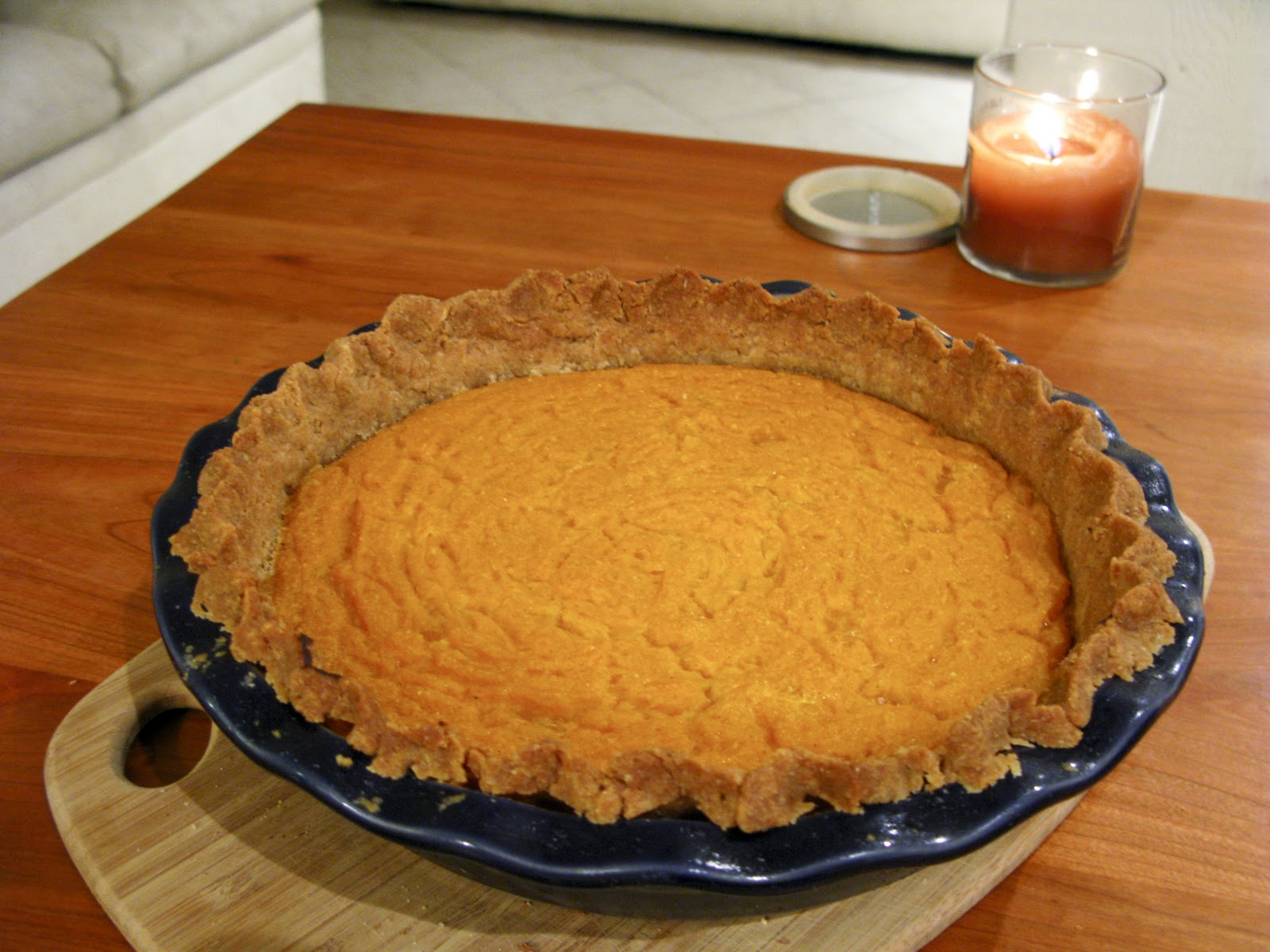
We read on the internet that fuyu persimmons should be eaten like apples. So we decided to cook them down like applesauce! Imagine our surprise when they began to smell and taste like sweet squash! So that's how the pumpkin/persimmon pie idea was born.


We began using the persimmons when they looked like this. However, we found out later that these are still not ripe. They tasted decent and cooked down great, but their prime comes when they turn a deep, almost reddish orange.

Like this:


Making sauce in our food strainer.

My first pie experiment. This one had tangerine slices in it! It was very yummy!


Cranberry - persimmon mixture

A mini version of our persimmon cranberry pecan pie

Making a persimmon cranberry crumble for potluck.

Our initial aim was to can all this sauce that we were making but our internet searches didn't turn up much information. I did find a few places that said that persimmons couldn't be canned because their pH was too high. Canned goods should have a pH lower than 4.6 to ensure that botulism won't grow. But we've also read in canning books that you can lower the pH of foods to a safe canning level by adding lemon juice or a powdered ascorbic acid that doesn't have a taste.

We wanted to can the sauce but because of our uncertainty, the first few batches of sauce that we made were either made into pies, cookies, or crumbles, or frozen in ziplock bags. But we hadn't given up on the canning idea quite yet. I was able to get some saliva pH testers at the health food store that went down to 4.5. We knew that if we could get it down to 4.5 with lemon juice and powdered acid, than things should be fine. The initial reading was about a 5.75. By adding a good deal of lemon juice (which we think enhances the flavor), we were able to lower it to about a 5. Then we added some Fruit Fresh, which is usualy used for keeping sliced fruit from turning brown. But it's first and second ingredients were citric acid and ascorbic acid so we figured it would work. It did! The pH came all the way down to a 4.5! Because of all the added lemon juice and the citric acid from the Fruit Fresh, it did have a bit more tang to it then I would have wished. I think next time I would go out and buy some ascorbic acid, which isn't supposed to have a taste.

So then we canned that batch - which made 3 quart jars full. I am still not certain of the validity of our approach because I've also read cautionary information about canning sauces that are too dense - such as pumpkin butter. This sauce is also quite dense and may not have heated up to the right temperature. So even though the pH has been lowered, I'm not sure I recommend others trying this method yet. I would have felt better about things had we pressure canned them but we don't have a pressure canner at this point.

Here are the cookies! And the cans of persimmon sauce behind them.


While you may not have your own persimmon tree in the backyard, the principle of this blog can still be applied in your daily life.  Whether it involves food, appliances, clothing, or any other item, using what you have on hand before buying something new is a sure-fire way to cut down on expenses, stuff, and stress.